How Do You Measure If SEO Work Is Successful?

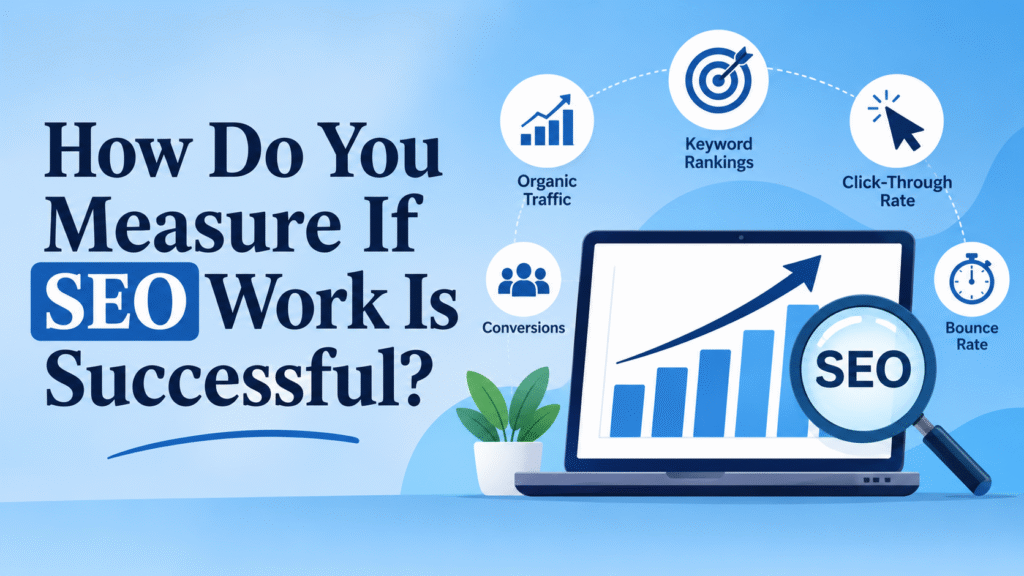
You have done your homework on search engine optimisation, the weeks have gone by and someone poses the obvious question – does it work at all? It is perfectly reasonable question. SEO is a process, which requires a lot of time, and opposite to paid advertising SEO doesn’t start working instantly after being implemented. Hence it is hard to get stuck in dashboards and reports filled with various technical information.
However, the good news is that SEO measurements do not have to be difficult. For this purpose you will need clear goals, certain number of indicators and some patience. The article will cover what kind of information you should measure and what you should leave out.
Begin by Defining Your Business Goals
Before even touching any software, first decide on what you mean by “success” for your business. A small hotel needs direct reservations. A solicitor needs enquiry calls. A web store needs sales. Visitors, in their own right, have little value if none of them result in a conversion.
State your goals in simple terms, and then give them a figure and a timeframe. For instance, boost your organic enquiries from twelve to thirty per month within nine months. All subsequent metrics that you will be measuring need to somehow fit within this goal statement. Otherwise, it is just noise.
Organic Traffic
Organic traffic refers to the people who visit via non-paid search engine results, and it is probably the most common form of SEO metrics. With Google Analytics, you can track the performance of this traffic separately and month-by-month or year-on-year without seasonal effects.
Do not stop at the headline figures here, however. See what pages drive visits, where they are coming from and whether the number of new visitors is increasing. An increase in blog traffic is good news for you, but an increase in visits to your service pages will be even better. Working with an SEO company Bristol that is trusted by many companies, you will receive a report that separates these types of traffic.
Keyword Rankings and Visibility
Keyword rankings reveal your rankings in relation to the searches your customers conduct. Monitoring rankings is an indication of whether you are improving visibility for the keywords that count. The Google Search Console is free and will provide you with information about average ranking positions and impressions/clicks for all keywords.
Approach rankings with some reservations. Results can differ based on location, device and personalized search. So a test in one’s own browser can reveal little. Monitor a specific set of priority keywords consistently and track trends instead of day-to-day fluctuations. Impressions should be monitored too. If impressions go up, Google is showing more people your pages, and that often precedes clicks. CTR is an important metric too. You have good rankings, but not many people click – it might mean that titles/descriptions should be rewritten.
Conversion and Leads
Traffic and rankings are only a tool to achieve something. The main thing here is to know how many people act in accordance with your wishes.
Conversions could be:
- Completion of forms
- Telephone calls
- Booking of services/products
- Downloads/purchases
You should set up these actions as goals or events in Google Analytics and track all conversions coming from each organic visit. After that, calculate conversion rates for organic visitors and compare it with other channels. In case traffic increased, but enquiries have not changed – there could be some problems with your target audience or page itself.
Use call tracking and the simple question “how did you find us?” in your enquiry form. Many users search, go away and come back typing the name of your company in search bar. You should just ask them. Each SEO services Bristol providers give guarantees to deliver you such tracking from the first day.
Signals of Engagement
The metrics of engagement are measures of the actions visitors take upon arrival. The average time on page, pages viewed per session and bouncing behavior suggest the degree to which your content matches the search intent. If a page captures attention and draws people forward, then it’s doing its work.
This information cannot be considered alone. It’s completely acceptable if the visit is short since all the visitor may have wanted was your business’ opening hours and contact number. What you must consider is how similar page types compare to one another and pages with high impressions and low engagement.
Backlinks & Authority
Links from other respectable websites continue to be among Google’s most powerful trust indicators. Consider the quantity of referring domains instead of links in total, and also consider the quality of those links. Links from even just one respectable site within the locality or from an industry association carry more weight than several links from directories of low quality.
Software like Ahrefs, Semrush and the links report available on Search Console track your progression. Also keep relevance in mind. When a café in Bristol is attracting links from local food bloggers and community pages, that’s good authority being built up, but lots of irrelevant links have no bearing whatsoever.
Technical Health
Technical SEO is the underlying basis upon which all other factors function. The following tools will help you assess technical health: Indexing report, Page experience report, and Core Web Vitals, which provide scores for page load time, interactivity, and visual stability. Also, monitor number of indexed pages, crawl errors, and mobile usability issues.
The sign of success will be the absence of problems – fewer errors, faster pages, and no broken links. Such factors are silent, but they often create results somewhere else. Pages that load faster usually have higher conversion rates, so you should connect technical improvements to conversions.
Local Visibility
If you are serving customers in a particular city, then local visibility needs to be measured separately. Google My Business provides insight into how many people found you through search and maps, asked for directions, called and visited your site. Review metrics should be kept in mind as well, such as the number of reviews and the speed of response.
The question to ask for the business in Bristol becomes quite clear. Do you feature in the map pack for local search queries in your city? Have the call volumes increased in Clifton, Redland and Bedminster? A local ranking tracking software could reveal how your ranking changes on a grid of your city rather than just checking your ranking from your desk.
Four Common Mistakes When Measuring SEO
There are a few things we tend to do which skew the performance of SEO in one way or another:
- Going for vanity metrics like total impressions that never impact the bottom line
- Not paying attention to branded searches, because by splitting them from non-branded you’ll find out whether you’re getting new people or not
- Doing too many changes at once to know what exactly was causing the movement
- Depending on a single tool while there are different views offered by Analytics, Search Console and a rank tracker
If you avoid all four mistakes above, you’re already half way there.
Be Patient and Compare Appropriately
A common error is to evaluate SEO prematurely. SEO campaigns generally require three to six months to be assessed effectively, while competitive markets may take longer.
The financial implications will appear later on, but early indications will include:
- Increasing impressions
- Increased number of indexed pages
- Higher rankings of lower competition keywords
Ensure that you compare appropriately. Make sure to use year-over-year analysis to avoid issues of seasonality, and maintain a list of events like changes in the site, creation of new content, and changes in algorithms to explain your observations. Beware of anyone who guarantees first page ranking in weeks.
Establish Your Own Reporting Rhythm
Set an interval for result analysis. Monthly result review is suitable for most SMBs: analyze organic traffic, conversions, leading queries, and any technical warnings. Do a quarterly analysis by looking back at your initial goals to see if your strategy corresponds to the current market state.
Don’t complicate the dashboard. Five-six key metrics known by everyone beat the 30-page unreadable report. Make sure the dashboard is viewed by decision-makers, including those who have financial authority, in order to evaluate the SEO results not based on assumptions.
Measure Your Outsourced Help
If you decide to outsource your needs, it is important that measuring be part of your contract from the beginning.
It is vital that an external help agency will:
- Have clearly agreed upon goals and baselines from the very beginning of cooperation
- Be able to make monthly reports in simple language
- Know how to describe changes that occurred and why they happened and how this will influence future plans
Do not believe any report saying great things about their ranking with some phrases that no one ever looked for. If you are searching for the best SEO company in Bristol, pay attention to their openness and willingness to share their experience, successes and failures.
Closing Thoughts
Quantifying SEO comes down to finding correlations between searching behavior and business outcomes. Start by setting objectives, monitor traffic, ranking positions, conversions, linking and site technical metrics, and analyze them month by month rather than day by day. Incorporate localized metrics when needed, and always question what the numbers mean in terms of money.
If the answer to this question is consistently affirmative, your SEO is working. If it isn’t, measurement will let you know where changes need to be made. Be it through hiring a traditional SEO agency Bristol or engaging a SEO company Bristol or choosing the SEO services Bristol based on recommendations, make sure they report on performance in terms of inquiries and sales. And if you are considering the best SEO company in Bristol, don’t be afraid to ask them how they measure their performance.
Related Blogs

7 tactics that benefit both accessibility and SEO
November 24, 2026