
How to spot and avoid AI content that hurts you: the line between helpful assistance and mass-produced filler.

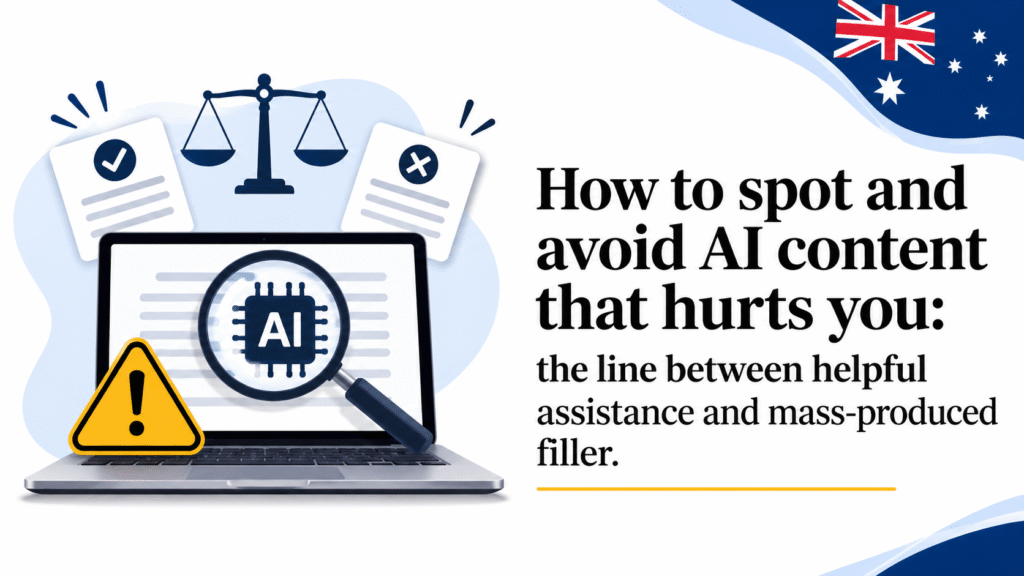
Thanks to AI writing software, it’s now feasible to create an entire month’s worth of blog content in just one afternoon. This is great news for many companies, but for others, it’s been a pitfall. Blogs that have been saturated with content created through machines have found themselves losing traffic, lower ranks on Google, and lost credibility among readers.
The issue isn’t the AI itself. The issue lies in how it’s being used. When used properly, it can save time and make ideas more concise. When not used properly, it can create content that adds nothing of substance to the conversation.
With this guide, you’ll learn how to spot the difference and how to audit the content that has already been published using AI technology.
Reasons for Concern about AI Content
In past times, publication took some work, and this was an automatic filter. Now, it is possible to write hundreds of articles within one day, and the web gets flooded with content that repeats all the same old ideas as everybody else.
For businesses, there are two reasons behind this problem:
- Firstly, search engines have even more incentives to choose. Among all those thousands of articles repeating the same information, the distinctive ones get highlighted.
- Secondly, readers have grown more aware of fluff content. It is known that people tend to leave immediately if the site feels fluffed up or impersonal.
Some content providers contribute to the problem themselves through quantity. If someone tries to sell SEO services in Australia based on tens of cheap articles each month, it is important to wonder who writes them, who proofreads them, and what they bring.
What Search Engines Really Value
One misconception is that Google punishes anything that is written with the help of AI tools. At least according to their public guidelines, this is not their approach. What matters is not how content is generated but if the content is valuable, original and made for people.
What search engines really care about is the content that is created on a large scale just for manipulation purposes and not for readers.
Such pages:
- Rehash the content that already exists without adding anything new
- Are created in bulk and do not pass any kind of quality control
- Are made purely for capturing search traffic
- Are full of mistakes, unsubstantiated claims or made-up facts
The question is not whether something was written using AI. It’s whether this content will bring any value to its reader.
Signals of AI Filler
Once you learn what to look for, bad writing becomes obvious. These are the most frequent ones.
Generic Introduction and Fillers
The vast majority of AI-written pieces begin with an opening paragraph about how critical this subject is “in the current fast-paced digital world.” It takes three paragraphs to get to the point and ends with a summary paragraph which just restates everything.
Watch out for:
- An introduction that can be used for any topic
- A sentence that merely restates the heading without saying anything new
- A conclusion that just repeats everything said earlier
No Practical Experience
Useful information will show you traces of a person who has actually worked on it. Fillers will make the writer seem like he knows a lot, but will not say anything that only he could know from practical experience.
Look for:
- No examples, specific situations, numbers, or case studies
- Universal advice which does not apply anywhere in particular
- No reference to local conditions, like seasons in Australia, laws or customer behavior in Australia
- No author identification, biography or proof of his experience
A web page titled “best SEO company in Australia” which does not give any actual cases, outcomes or techniques is a good example of this.
Repetitive Structure and Language
Content produced on mass usually adheres to the same structure across dozens of pages with identical heading and sentence structures and transitions.
Such tell-tale signs can be found:
- Opening sentences that always begin in the same way
- Overuse of such words as “crucial,” “robust,” “seamless” and “landscape”
- Lists that are made up of either five or seven points regardless of the subject of the text
- Paragraphs with almost identical length
Vague Assertions and Lack of Source Material
AI systems are able to say things with confidence that are either false or not verifiable. This is one of the most dangerous issues because mistakes tend to destroy trust quickly.
Beware of:
- Numbers without any source
- Assertions such as “studies have shown” or “experts claim” without any reference
- Out-of-date facts as current
- False facts about products, laws, or pricing
Keywords Forced Unnaturally into Text
There is filler text that revolves around a keyword without much else going on. It is found in each paragraph, even in strange phrasing, since the document was meant for a crawler rather than a reader. Good writing includes a keyword and then goes on.
Where the Line Is Drawn Between Constructive Aid and Filler Content
AI is not the enemy. It comes down to who controls the process. Imagine an AI as an instrument controlled by a professional rather than a substitute for a professional.
Useful cases:
- Help generating topic and angle ideas
- Constructing an outline out of your notes
- Writing a first draft out of your interview or call record
- Providing alternative titles for testing
- Checking grammar, coherence and readability
- Condensing a full page to a social media post
Cases to avoid:
- Publishing unedited, unchecked raw text
- Creating multiple articles around vaguely relevant keywords
- Rewriting competitors’ content with minor alterations
- Creating “expert content” on subjects nobody on your team understands
- Falsifying reviews, quotes, author names or case studies
An easy test to apply: If a knowledgeable member of your team can’t defend every sentence on that page – it’s not ready to go live yet.
How to Audit Your Current Content
If you have existing AI-powered pages, there’s no need to freak out or remove them all. A measured audit can reveal how much work is needed.
Step 1: Gather Your Stats
Visit Google Search Console and your analytics and look back over the past 6-12 months for pages with:
- Decreasing impressions or clicks
- High bounce rate with very short sessions
- Pages that have never shown up on any SERP
Step 2: Review Each Page as a Consumer
Read each marked page as if you were seeing it for the first time.
Question yourself about whether:
- It answers the question efficiently.
- It provides unique information that cannot be found on five other Web pages.
- Do I trust the individual or organization responsible?
- Is there any outdated or incorrect information?
Step 3: Decide What You Should Do
Pages fall into any of the four categories listed below:
- Keep: the page is accurate, helpful and functional
- Improve: the theme is correct, but the page should be enriched with examples, relevant data, and human language
- Merge: several poor pages that deal with the same theme can be united into one excellent page
- Delete: the page doesn’t add anything and has no traffic and links
If you cooperate with an SEO company in Australia, please, order them to conduct such an audit of your content before they create anything.
Safe Process to Use AI
You can use AI technology and still create content that people will find valuable. With this process, the human element remains in control.
- Have a concrete idea: Start with a customer query, a sales discussion or an issue that your team commonly resolves.
- Add your own content: Collect facts, figures, images and other details from your own knowledge prior to writing.
- Let AI write the outline and draft: Allow AI to assist you in creating outlines, first drafts and alternate wording.
- Do heavy editing: Write using your own words, remove fluff and add your unique content.
- Double check all the facts: Make sure that all the statistics, names, dates and assertions are correct.
- Include a human author: Cite a person with appropriate background, including a brief biography.
- Have the content reviewed: Let a person knowledgeable in the topic review the content and question anything ambiguous.
Choosing an Outsourcing Company That Won’t Pollute Your Site with Filler
Hiring some external services? The way they manage content is a clear indicator of quality. Many entrepreneurs begin by researching for the best SEO agency in Australia and selecting one according to ranking. It’s much more efficient to find out how exactly they work.
Questions to ask:
- Who produces and edits your content and what’s their experience?
- How do you integrate AI into your process and review its output?
- Are there any examples of the projects where you gained traffic and leads, not just rankings?
- How do you perform the fact-checking and referencing process?
- Do you have an approach to auditing and improving already existing pages, not just creating new ones?
- What is your reporting strategy and does it show the results of your business?
Don’t be too attracted to the companies that can provide you with thousands of articles for a really cheap price or even guarantee rankings. It’s usually a red flag for filler creation.
Conclusion
AI is not the threat – publishing without a proper approach is. Useful content will continue getting its deserved attention while content just filling up space will continue being overlooked regardless of whether it was generated using AI or not.
Use AI as an aid that will help you make mundane tasks easier, but do not outsource thinking, expertise, and decision-making to it. Perform an audit of your previously published material, get rid of poor-quality pages and establish a standard for any future material.
Regardless of whether you are going to take care of all of that on your own or find an SEO services in Australia that can help you, make sure to hire people who understand the importance of substance and can prove it by explaining how they verify their work. The best SEO company in Australia for your business is not the one that publishes more pages than others. It’s the one that helps you publish pages worth reading.
Related Blogs


Will AI Replace SEO Experts? An Honest Look for Business Owners
November 18, 2026