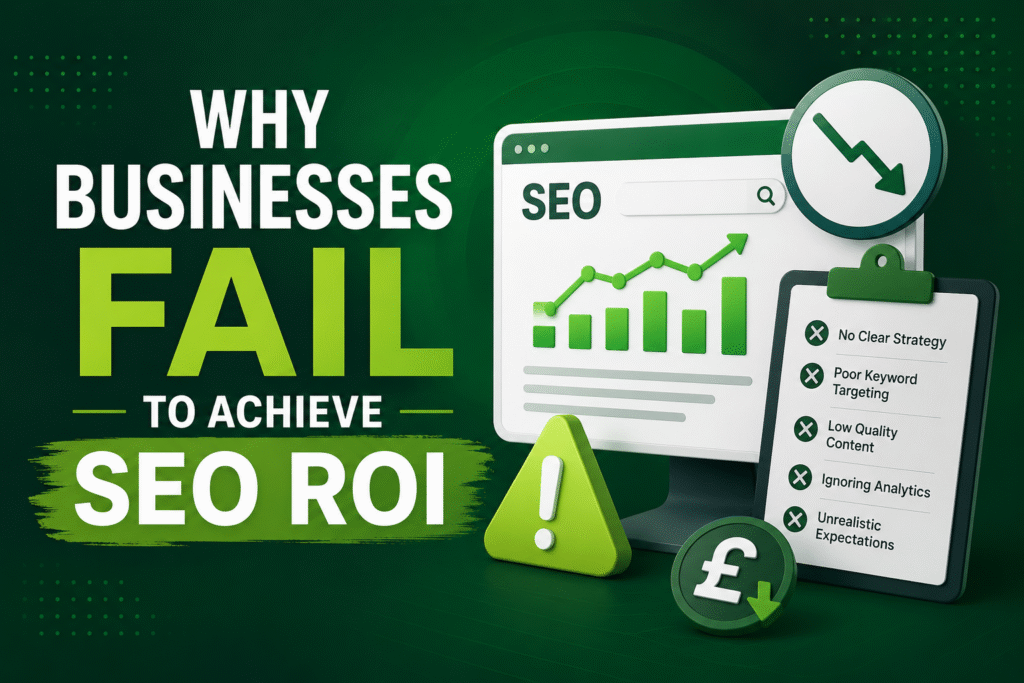
Why Businesses Fail to Achieve SEO ROI

Search Engine Optimization (SEO) is one of the most effective digital marketing strategies available today. It helps businesses improve online visibility, attract qualified visitors, and generate long-term growth. However, despite investing significant resources into SEO, many companies struggle to achieve a positive return on investment (ROI).
This often leads business owners to question whether SEO is worth the effort. In reality, SEO can produce exceptional results when implemented correctly. The problem is usually not the strategy itself but the mistakes businesses make throughout the process. Whether you’re investing in a Seo service in uk or managing SEO internally, understanding the common reasons behind poor SEO ROI can help you make better decisions and achieve stronger results.
What Is SEO ROI?
SEO ROI refers to the value generated from SEO activities compared to the costs involved. A successful SEO campaign should contribute to measurable business outcomes such as:
- Increased organic traffic
- More qualified leads
- Higher conversion rates
- Better brand visibility
- Increased revenue
Many businesses focus only on keyword rankings and forget that SEO’s primary purpose is to generate business growth.
Unrealistic Expectations
One of the biggest reasons businesses fail to achieve SEO ROI is expecting immediate results.
Unlike paid advertising, SEO is a long-term strategy. Search engines need time to crawl, evaluate, and rank content. Depending on competition and industry, meaningful improvements may take several months.
Many businesses partner with a Seo agency in uk expecting first-page rankings within weeks. When results do not happen immediately, they often abandon their SEO efforts too soon.
SEO rewards patience, consistency, and long-term commitment.
Focusing on Rankings Instead of Revenue
Ranking improvements are important, but rankings alone do not generate revenue.
Many businesses celebrate reaching the first page of Google only to discover that their leads and sales remain unchanged.
The true purpose of SEO is to drive business growth through:
- Qualified traffic
- Lead generation
- Customer acquisition
- Revenue growth
Success should always be measured by business outcomes rather than vanity metrics.
Targeting the Wrong Keywords
Keyword selection plays a critical role in SEO success.
Many companies focus on high-volume keywords without considering search intent. This often results in attracting visitors who are not interested in their products or services.
A successful keyword strategy focuses on:
- Commercial intent
- Buyer intent
- Local opportunities
- Long-tail keywords
- Industry relevance
Attracting the right audience is far more valuable than generating large amounts of untargeted traffic.
Poor Website User Experience
Traffic alone does not guarantee results.
If visitors arrive on a website that is slow, confusing or difficult to navigate, they are likely to leave without taking action.
Common user experience problems include:
- Slow page speed
- Mobile compatibility issues
- Poor navigation
- Cluttered layouts
- Weak calls-to-action
- Lack of trust signals
Search engines increasingly prioritize websites that deliver positive user experiences.
Weak Content Strategy
Content remains one of the strongest ranking factors in SEO.
Unfortunately, many businesses publish content simply to increase page count rather than provide genuine value.
Low-performing content often contains:
- Generic information
- Thin content
- Outdated insights
- Poor formatting
- Little originality
Successful content should answer questions, solve problems, and help users make informed decisions.
Businesses that consistently publish useful content often see stronger SEO performance and improved ROI.
Ignoring Search Intent
Search intent is one of the most important aspects of modern SEO.
Google aims to provide results that best match what users are looking for. If content fails to align with user intent, rankings and conversions can suffer.
The main types of search intent include:
Informational Intent
Users are looking for information.
Commercial Intent
Users are researching products or services.
Transactional Intent
Users are ready to make a purchase or inquiry.
Navigational Intent
Users are searching for a specific website or brand.
Understanding search intent helps businesses create content that satisfies user expectations and improves conversion rates.
Neglecting Technical SEO
Many businesses focus on content while overlooking technical SEO.
Technical SEO ensures that search engines can properly crawl, index, and understand website content.
Common technical issues include:
- Broken links
- Duplicate content
- Crawl errors
- Missing metadata
- Poor site structure
- Slow loading pages
Without a strong technical foundation, even the best content can struggle to rank.
Lack of Conversion Optimization
Generating traffic is only part of the process.
If visitors are not converting into leads or customers, SEO ROI will remain low.
Businesses should continuously optimize:
- Contact forms
- Landing pages
- Service pages
- Calls-to-action
- Lead generation funnels
Small improvements in conversion rates can significantly increase the value of existing traffic.
Inconsistent SEO Efforts
SEO requires consistency.
Many businesses invest in SEO for a few months and then stop when results are not immediate.
Successful SEO campaigns involve:
- Ongoing content creation
- Continuous optimization
- Performance monitoring
- Technical maintenance
- Authority building
Search engines reward websites that consistently provide value and remain relevant over time.
Poor Link Building Practices
Backlinks remain a major ranking factor.
However, many businesses make the mistake of focusing on quantity rather than quality.
Common mistakes include:
- Buying low-quality backlinks
- Using link schemes
- Acquiring irrelevant links
- Ignoring authority signals
High-quality backlinks from trusted and relevant websites help improve credibility and visibility.
The best Seo agency in uk understands that sustainable link building focuses on earning authority rather than manipulating rankings.
Failure to Track Performance Properly
Many businesses fail to measure the right SEO metrics.
Without accurate tracking, it becomes difficult to understand what is working and where improvements are needed.
Important metrics include:
- Organic traffic
- Lead generation
- Conversion rates
- Customer acquisition
- Revenue generated
- User engagement
A reputable best seo company uk focuses on business-focused metrics rather than simply reporting keyword rankings.
Choosing the Wrong SEO Strategy
Not every SEO strategy is suitable for every business.
Some companies follow generic approaches that fail to align with their goals, industry, or target audience.
A successful SEO strategy should be tailored to:
- Business objectives
- Market competition
- Customer behavior
- Geographic location
- Industry requirements
Custom strategies typically outperform one-size-fits-all solutions.
Lack of Patience
SEO is often compared to investing rather than spending.
Businesses that constantly switch providers, change strategies, or abandon campaigns rarely give SEO enough time to succeed.
Authority, trust, and visibility take time to build.
Organizations that remain patient often see the strongest long-term returns.
Failure to Adapt to Industry Changes
Search engines constantly evolve.
Google regularly updates its algorithms to improve search quality and user experience.
Businesses that fail to adapt risk losing visibility and falling behind competitors.
Areas that require ongoing attention include:
- AI-powered search
- User experience improvements
- Content quality standards
- Mobile optimization
- Search intent changes
Staying informed helps businesses remain competitive in an evolving digital landscape.
How to Improve SEO ROI
Businesses can significantly improve SEO ROI by:
- Setting realistic expectations
- Focusing on revenue rather than rankings
- Targeting the right keywords
- Improving user experience
- Creating valuable content
- Optimizing conversions
- Monitoring performance regularly
- Building quality backlinks
- Maintaining consistency
These practices help create a sustainable foundation for long-term SEO success.
Conclusion
SEO remains one of the most powerful marketing channels available, but achieving a strong return on investment requires a strategic and patient approach. Businesses often fail to achieve SEO ROI because they focus on the wrong metrics, target ineffective keywords, neglect user experience, or expect immediate results.
By understanding these common challenges and implementing proven best practices, organizations can unlock the full potential of organic search. An experienced seo marketing agency uk can help businesses develop a strategy that aligns with their goals, improves visibility, generates qualified leads, and drives sustainable growth over the long term.
Related Blogs
Industries That Benefit Most from SEO Services in the UK
June 23, 2026