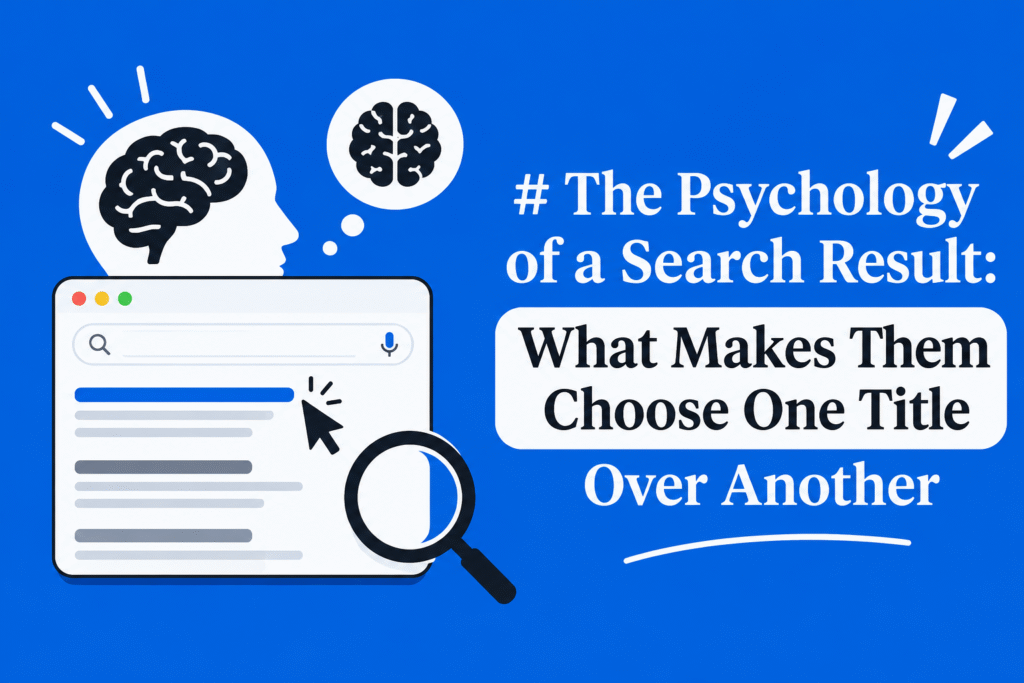
The Psychology of a Search Result: What Makes Them Choose One Title Over Another

Type a query on Google and within less than two seconds, you will make up your mind. You have ten links, some ads, maybe a snippet from an AI tool, and you click on one of the results, while ignoring the others. Why do you do so? You cannot tell me. But a good SEO company Uk that any business trusts knows very well why.
There’s much more psychology behind such clicks. The user is not trying to read and think about your title; they just skim, speculate and follow their gut feelings. Knowing that psychological process can be a great advantage for any marketer, as ranking doesn’t matter unless somebody chooses to click on it.
Let’s explore what actually happens in the head of the searcher and how to write titles to get clicked.
The Two-Second Scan
There’s no such thing as reading a results page; it’s all about scanning, the same way you would pass by store windows. Your eyes scan through the titles, checking the first words of each result against what’s on the mind, then move on. This is called satisficing – people are not searching for a perfect solution but accepting any one that fits the bill.
Take an example of a customer typing SEO company UK. He will have to go through about ten results within seconds. The decision will be made based on the first words of each title, which is why it’s so important for the first three to five words of your title to catch attention. If they don’t give out anything relevant, the whole title is going to be skipped in a couple of seconds. Position also counts; your title has to be convincing enough to compete with the first results.
Information Gaps: How Curiosity Creates Clicks
According to the information gap theory put forward by George Lowenstein, curiosity arises in situations where a person notices the gap between what he knows and what he wants to know. A good title should create that gap that needs to be filled.
Let us compare titles “Tips on Writing Effective Email Subject Lines” and “The Secret of Email Subject Lines That Take Away Half of Your Opens”. The second title creates a small gap. You need to know what the secret is. The only way you can discover it is to click on the link.
However, there is one problem here. If people feel curious about something they see in a title, they expect to find an answer to their question on a webpage. Otherwise, they will close it instantly because people tend to forget about clickbait.
Specificity Increases Credibility
Generic titles sound scary. Specific titles sound safe. “How to Build Your Business Online” is a title you’ve probably seen before countless times. “How a Three-Person Bakery Increased Online Orders by Twice Over Eight Weeks” sounds like something real.
Numbers, timelines, real situations and actual results make the reader less scared of what they are searching for. This is even more true in competitive markets. Let’s take an example of a person looking for the best SEO Agency in UK. He must have come across a bunch of generic promises, but none of them mean anything.
First Comes Emotion, Then the Rationale
Humans love to believe they react rationally. But, in reality, emotions come first and rationale follows to support it. The title which generates emotions such as relief, curiosity, FOMO, or hope gains the user’s attention before forming an opinion using the rational side of the brain.
Let us take the example of the emotions which can be generated by the searches. The person searching for “why is my website not showing on Google” is not searching for information in a composed manner. He or she is panicking and possibly embarrassed and in need of assurance. “Your Website Isn’t Broken: Five Reasons It’s Hiding From Google” does so while “Website Visibility Factors Explained” does not.
Same goes for the person who comes to your company providing seo services uk because of a negative experience with another service. This person is not only looking for a list of companies he or she can turn to. He or she is looking for someone who will not fail him or her and this must be shown in your title.
The trick is in balancing the emotional temperature of the search.
Intent Has a Tone
Informational, commercial, and transactional intent – marketers distinguish between them, and that is helpful. But there is another aspect to this that is overlooked: intent has a tone. Two users may type in exactly the same words from completely different states of mind.
Consider a small business owner who searches for seo services uk. One user may be at the discovery stage and wants to know what this entails and how much it will cost him. Another may already shortlist three companies and needs a bit of encouragement. The first one expects to get an explanation, while the second one – some evidence of credibility and the reason to trust you. Both needs cannot be addressed by a single headline, so effective pages focus on one type of intent.
The type of intent can be determined by the results page layout. If it is packed with various guides and comparison tables, users are at the discovery stage. Service pages with prices and reviews prevail? They are already making their move.
Social Proof and the Safety Instinct
Human beings are herd animals when faced with uncertainty. This means that we follow the crowd because the crowd has done the risk assessment for us. Social proof in search results takes the form of review stars, well-known brand names, publication dates, and such words as “trusted by 2,000 companies.”
Every little detail counts. The fact that the publication is dated recently proves that it is current. The fact that the domain is recognizable makes you feel safe rather than the opposite. A title that mentions some tangible result or real-life customer makes you think that people have already done the job for you.
This is why you cannot afford to play on words in case of a less recognizable business. If a customer is looking for a SEO company UK and sees ten different names none of which he or she recognizes, they will not usually follow up with the link to the page they do not know unless it gives them some kind of security signal.
Test What the Behavior of Your Audience Actually Is
Theoretical approach will get you nowhere because there is no average reader; only testing can reveal the behavior of your target audience. Google’s Search Console indicates CTR for each keyword and page, so it is very easy to find pages ranking but receiving little traffic.
Select those pages, change something in the titles of those pages, one thing at a time, something that corresponds to one psychological trigger, such as number, more potent emotion or a promise and observe the results during several weeks. Over several months, you will learn much more about your audience than any advice in general could tell you.
This is precisely how the best SEO agency uk work: not by using some trick, but by having a habit of observing behavior and improving it incrementally. A landing page on SEO services UK, for example, should indicate whom it is for, what services it offers and how the first month looks.
Write For the Person, Not the Algorithm
Clicks are little acts of trust. Someone looked at a few choices, felt something about them, and clicked on yours. Good titles do so by being specific, emotionally intelligent, straightforward about their offering, and distinctive enough to stand out.
It doesn’t matter if you own a local coffee shop or are part of a growing SEO company uk, you always need to know who the person asking the question is before writing the first word. Ranking gets your foot in the door; psychology gets someone to walk through it.
If you are deciding which agency to use, the best seo agency in uk will know how to treat searchers as human beings, test their assumptions, and explain their reasoning in plain English.
Go small first. This week, choose three titles, rewrite them using just one thing from this article, and see what happens. That click might be the beginning of a customer relationship.
Related Blogs


7 tactics that benefit both accessibility and SEO
November 24, 2026